When people ask how long ketamine lasts, they’re often asking three different questions at once.
- How long will the infusion session itself take?
- What will the experience during and after treatment feel like, and for how long?
- How long might the therapeutic benefits last?
Ketamine is a dissociative anesthetic that has been used in medical settings for decades. In recent years, its application has expanded into the treatment of treatment-resistant depression, post-traumatic stress disorder (PTSD), anxiety, bipolar depression, and other conditions that have not responded adequately to conventional approaches. Understanding the timeline of ketamine therapy, from the first minutes of an infusion to weeks of potential symptom relief, helps patients know what to expect before they begin.
How long does ketamine last?
The answer depends on which aspect of ‘lasting’ you are asking about. Ketamine therapy involves three distinct timelines: the length of the session, the duration of the immediate dissociative effects, and the duration of the therapeutic benefits that follow.
The infusion session
A typical IV ketamine infusion at Keta Medical Center takes approximately 45 minutes. After the infusion ends, patients remain in a private, supervised room for monitoring. Most patients are in the clinic for about 90 minutes, from the start of the infusion until they are ready to leave.
For patients who qualify for Spravato® (an esketamine-based nasal spray), the treatment session follows a different protocol. The dissociative effects of Spravato last approximately 45 minutes. The FDA requires patients to remain in the clinic for 2 hours after administration. Spravato is FDA-approved for treatment-resistant depression and is covered by insurance.
The immediate dissociative experience
During a ketamine infusion, patients experience a temporary dissociative state: a mild sense of altered perception or detachment from their surroundings. This is a known and expected effect of ketamine at therapeutic doses. Our clinical team prepares every patient in advance and provides active support throughout the session.
For most patients, the dissociative effects of Spravato and IV ketamine resolve as the infusion ends or shortly thereafter. Mild grogginess or cognitive haziness may persist for an hour or two after leaving the clinic, which is why patients should arrange transportation and avoid driving after their treatment. Side effects are generally mild and may include temporary dizziness or nausea.
How long ketamine stays in the body
A commonly searched question is how long ketamine remains detectable in the system. IV Ketamine has a half-life of approximately 2 to 3 hours in adults, meaning half of the drug is cleared from the bloodstream in roughly that time. The drug is effectively eliminated from the body within 10 to 15 hours of administration, with trace metabolites potentially persisting slightly longer.
Critically, the clearance of ketamine from the bloodstream is not the same as the end of its therapeutic effects. The antidepressant and mood-stabilizing benefits of ketamine persist well beyond the point at which the drug is no longer detectable: this is one of the most clinically interesting properties of ketamine as a treatment.
How quickly can you see results?
One of ketamine’s most significant clinical distinctions from conventional antidepressants is the speed at which it can produce therapeutic benefit. Traditional antidepressants, including selective serotonin reuptake inhibitors (SSRIs) and serotonin-norepinephrine reuptake inhibitors (SNRIs), typically take 4 to 12 weeks to show a meaningful response, if they work at all. Ketamine works through an entirely different mechanism.
Rather than targeting serotonin or norepinephrine, ketamine acts on the glutamate system: specifically, it blocks NMDA receptors in the brain. This triggers a downstream cascade: the release of brain-derived neurotrophic factor (BDNF), activation of AMPA receptors, and the formation of new synaptic connections, a process called synaptogenesis. These effects are believed to underpin ketamine’s unusually rapid antidepressant action.
Within 24 hours
Clinical research published in peer-reviewed literature, including studies from the National Institutes of Health and landmark trials conducted at Yale University, has consistently shown that ketamine can produce significant reductions in depressive symptoms within hours of a single infusion. In this study, a 71% response rate was observed at 24 hours post-infusion. The peak antidepressant effect is generally observed within 24 to 72 hours.
Spravato (esketamine) has shown similar rapid effects in its own landmark trial: in TRANSFORM-2, patients treated with esketamine showed a statistically significant improvement in depressive symptoms compared to placebo within 24 hours of the first dose, an effect that was largely sustained through the four-week study period.
Duration after a single infusion
For patients who respond to a single ketamine infusion, the therapeutic benefits may last anywhere from several days to approximately two weeks. Research shows most patients experience some symptom return within 7 days, though this varies by individual. This is why treatment follows an induction protocol: a series of infusions over a defined period to build and extend benefits before moving to maintenance. The anti-fatigue, anti-anxiety, and mood-stabilizing effects follow a similar pattern, and integration therapy between sessions is encouraged to help sustain these gains.
Duration with a series of infusions
At Keta Medical Center, ketamine is typically administered as a structured series of infusions rather than a single session. A multi-infusion approach is consistently associated with more durable therapeutic outcomes. Published research on repeated-dose protocols reports that among patients who respond, the median time to symptom return following a completed series can extend to several weeks. In one open-label study involving patients with treatment-resistant major depression, 70.8% of participants met response criteria by the end of a 12-day series of up to 6 infusions, and many responders maintained that benefit for weeks afterward.
Maintenance or booster infusions can help extend the period of relief for patients who respond well to their initial series. The appropriate frequency of maintenance treatment is determined individually by a clinician based on the patient’s response and clinical picture.
What affects how long the results last?
Several factors influence the duration of ketamine’s therapeutic benefits, including:
- The nature and severity of the underlying condition
- Prior treatment history and whether the patient has treatment-resistant depression or another qualifying condition
- Whether ketamine therapy is integrated with adjunct treatments such as psychotherapy
- General health, sleep, lifestyle factors and the patient’s neurobiological response
Long-term efficacy of Spravato
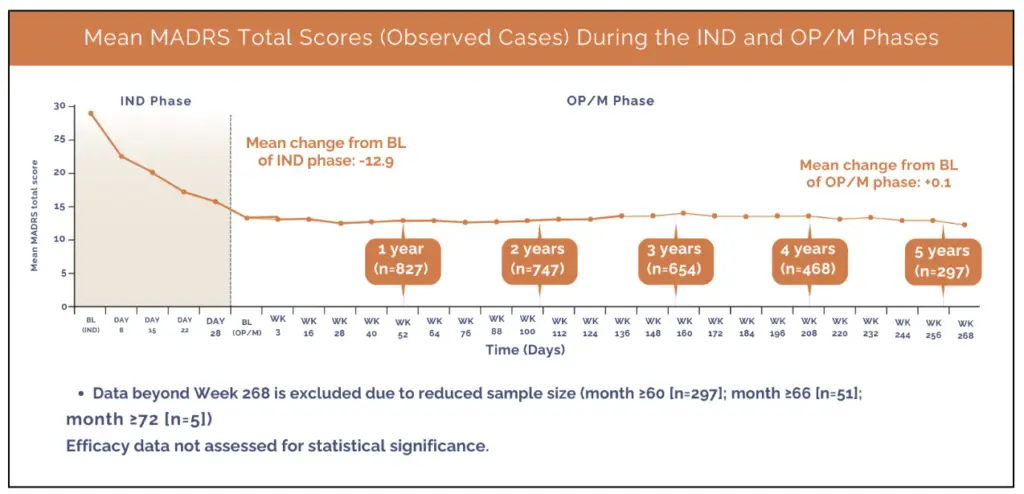
Long-term data support the value of staying on a maintenance schedule. A multi-year study of esketamine (Spravato) followed patients for nearly 5 years and found that improvements achieved during the first 4 weeks of treatment were sustained through the optimization and maintenance phase, with half of participants in remission by the study endpoint. Remission rates rose from 35.6% at the end of induction to 46.1% during ongoing maintenance, reinforcing that consistent, well-managed treatment extends results well beyond what a single session can achieve.
Our clinicians evaluate all of these factors when developing a personalized treatment plan. No two patients’ timelines are identical, and results will vary.
Ketamine therapy at Keta Medical Center
At Keta Medical Center, ketamine therapy is administered under the supervision of experienced emergency medical physicians in a private, spa-like setting designed to support patient comfort and safety. We take a thorough, individualized approach, from the intake evaluation through the final follow-up, to ensure that every patient’s care is thoughtfully calibrated to their needs.
We offer both intravenous ketamine infusions and Spravato for eligible patients. Spravato is FDA-approved for treatment-resistant depression, while IV ketamine is used off-label for a range of conditions, including PTSD, anxiety, bipolar depression, postpartum depression, OCD, and others. Our team will assess which option is most appropriate during your consultation.
Beyond physician-led ketamine therapy, Keta Medical Center also offers psychiatry and therapy services, meaning care can be tailored to your full picture rather than a single treatment approach. We actively monitor evolving research on ketamine to ensure our protocols reflect the current state of the evidence.
If you are living with a condition that has not responded to conventional treatment and want to understand whether ketamine therapy may be appropriate for you, we encourage you to speak with our clinical team.
FAQs
How long does the dissociative experience last?
The temporary dissociative state, a mild sense of altered perception or detachment, typically lasts for the duration of the infusion (around 45 minutes) and may continue for an hour or two after the session ends.
How quickly can ketamine relieve depression symptoms?
Ketamine can begin to produce meaningful antidepressant effects within days. A randomized controlled trial found significantly greater reductions in depression severity 24 hours after a single ketamine infusion compared to placebo, with response rates more than double those seen with placebo.
How long do the antidepressant effects of ketamine last?
After a single infusion, many patients who respond report symptom relief lasting approximately 7 to 14 days, though individual results vary. A structured series of infusions is associated with more sustained outcomes. Maintenance sessions for Spravato or booster sessions for IV ketamine can help extend the benefit further.
How long does ketamine stay in the body?
Ketamine has a half-life of approximately 2 to 3 hours and is effectively cleared from the bloodstream within 10 to 15 hours of administration, according to NIH StatPearls. Trace metabolites may persist slightly longer. Importantly, ketamine’s therapeutic effects last well beyond the window in which the drug is detectable in the body; the two timelines are distinct.
How many ketamine infusions will I need?
The appropriate number of infusions depends on the individual and the condition being treated. Keta Medical Center evaluates each patient individually and recommends a personalized protocol, but most patients follow a structured induction phase before moving to less frequent maintenance treatment.
For IV ketamine, the standard induction series is 6 infusions over 3 weeks, followed by periodic booster infusions based on individual response.
For Spravato (esketamine), induction typically consists of 8 sessions over 4 weeks, followed by a 4-week optimization phase of 1 session per week, then a transition to an ongoing maintenance schedule.
Our clinicians will outline the recommended approach for your specific protocol and monitor your response throughout treatment.