If you are considering ketamine therapy for depression, anxiety, or another condition, safety is likely one of your first concerns. And it’s a fair question to ask.
Ketamine is a dissociative anesthetic that has been safely used in medical settings for decades. Its complicated public reputation stems mainly from its history as a recreational drug, along with the media attention that history has received, rather than from its clinical use.
But here’s the short answer: When administered by trained medical professionals in a monitored clinical setting, ketamine therapy is safe.
Below, we break down what the clinical research shows, how addiction risk differs in a supervised setting compared with recreational use, and how patient safety guides every aspect of care at Keta Medical Center — from sessions supervised by medical staff to clinical treatment protocols.
Is ketamine therapy safe?
Yes. Across decades of clinical use and hundreds of registered clinical trials for depression, there have been no reported deaths and no serious cardiac events tied to individuals receiving sub-anaesthetic ketamine for psychiatric disorders in a supervised medical setting.
That safety record exists alongside a very different reputation in the public eye. Media coverage of ketamine has often focused on recreational misuse or on deaths linked to unsupervised, unregulated use, sometimes at doses and purity levels far outside anything used in medical care.
The risks associated with illicit ketamine use, whether from contamination, unknown dosing, or lack of medical oversight, are not the same risks present when ketamine is administered by trained physicians in a monitored clinical setting like at Keta Medical Center.
Ketamine has also become one of the most extensively studied treatments for depression over the past two decades, the subject of thousands of scientific papers and hundreds of registered clinical trials, and it’s referenced by major medical organizations that oversee psychiatric treatment standards.
Ketamine’s safety profile has also been studied against other established treatments. A study comparing ketamine with electroconvulsive therapy (ECT) for treatment of depression found that ketamine was associated with fewer adverse events than ECT (25.1% versus 32.4%), along with less impact on memory recall. Ketamine was also found to be non-inferior to ECT, with 55% of patients responding to treatment compared to 41% in the ECT group.
Randomized, placebo-controlled trials have repeatedly found that ketamine can rapidly reduce depressive symptoms in patients with treatment-resistant depression. In a large clinical study of this population, nearly 70% of patients on Spravato® achieved a clinical response and more than half achieved remission, with long-term follow-up showing 46% remained in remission after up to 4.5 years of maintenance treatment, with no new safety concerns identified over that period.
Is it safe to use ketamine at home?
Not in the way it’s often marketed, and this is where much of ketamine’s dangerous reputation actually comes from. A number of telehealth companies now ship compounded ketamine lozenges or troches directly to patients for unsupervised, at-home use, and that’s a fundamentally different practice from clinic-based ketamine therapy.
In October 2023, the FDA warned that these products are not FDA-approved for any psychiatric use and that taking them without a health care provider monitoring for sedation, dissociation, and changes in vital signs puts patients at risk. Several hospitalizations and deaths tied to unsupervised at-home use, including a widely reported case involving actor Matthew Perry, have reinforced that warning, and a case report published in the American Journal of Psychiatry documented a patient who suffered an unintentional overdose after receiving inconsistent instructions from a telehealth provider during at-home treatment.
Patients deserve to hear this plainly: the safety record in this article describes ketamine given on-site by trained staff, not mail-order ketamine used alone at home. News coverage rarely draws that line, so people assume medical ketamine is the danger, when the real common thread is no supervision. At Keta Medical Center, every dose is given on-site, under direct clinical supervision, and that’s what sets us apart from the headlines.
Is ketamine addictive in a clinical setting?
When ketamine is administered in a medically supervised setting, the risk of developing addiction is extremely low, and there have been no published reports of addiction developing within clinical trials for depression. Long-term follow-up studies also have not found evidence of physical dependence, even months or years after treatment ended.
This differs significantly from recreational ketamine use, which may involve frequent exposure, larger or unpredictable doses, and no medical oversight. Although ketamine can be misused and addiction remains possible, the risk in a properly screened and monitored patient is substantially different from the risk associated with unsupervised use.
The DEA classifies ketamine as a Schedule III controlled substance. This means it has an accepted medical use but also carries the potential for misuse and psychological or physical dependence. Its controlled-substance status is one reason appropriate patient screening, careful dosing, ongoing monitoring, and administration by qualified medical professionals are essential.
How Keta Medical Center creates a safe, supportive environment
Safety at Keta Medical Center starts well before a single dose is administered. Every patient goes through a thorough intake evaluation with our clinical team, covering medical history, current medications, cardiovascular risk factors, and any past experience with substance use. This process helps us determine whether ketamine therapy is a suitable fit within a broader, personalized treatment plan.
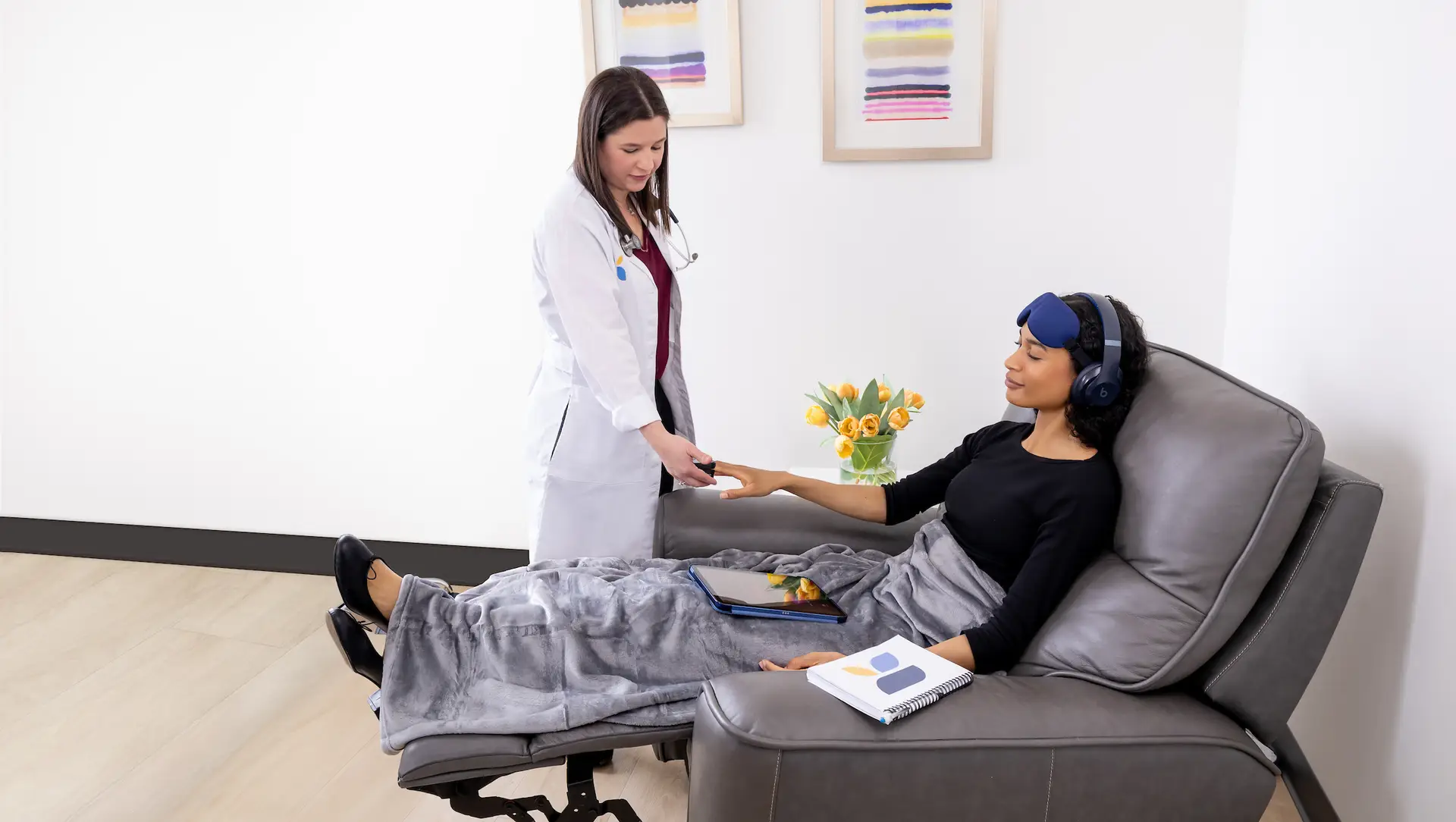
Treatment itself takes place in a private room, supervised throughout by experienced emergency medicine physicians. For IV ketamine infusions, a typical session lasts approximately 40 minutes to an hour, and patients are monitored for safety and comfort for about 90 minutes in total. Vital signs, including heart rate, blood pressure, and oxygen levels, are tracked throughout the infusion.
For Spravato (esketamine) nasal spray, patients are monitored on-site by the medical team for at least two hours after each dose, with blood pressure, heart rate, and oxygen levels checked at the beginning, 40 minutes post-dose, and at the end.
What side effects can patients expect?
During treatment, ketamine produces a temporary dissociative state, a sense of altered perception or detachment from one’s surroundings. This is a known and expected effect of the medication at therapeutic doses, and it resolves as the infusion or nasal spray session ends.
In a review of Spravato safety data collected over 12 months of treatment, the most common side effects during the first week of treatment were dizziness (20.6%), dissociation (16.7%), nausea (14%), vertigo (12.1%), increased blood pressure (4.3%), and sedation (3.8%), and each of these decreased in frequency with continued treatment.
Most patients feel back to their baseline well before they leave our clinic.
Who should avoid ketamine therapy?
Ketamine therapy is not appropriate for everyone. It’s generally not recommended for people with certain cardiovascular conditions (including uncontrolled hypertension or aneurysmal vascular disease), a history of intracerebral hemorrhage, an arteriovenous malformation, a history of psychosis, an active substance use disorder, or other contraindications that a physician would need to evaluate individually. Patients who are pregnant or planning to become pregnant should also discuss this with their care team.
For a closer look, see our article: Who Is a Good Candidate for Ketamine Therapy?
Talk with our clinical team
If you are deciding whether ketamine therapy may be a safe option for you, the most reliable next step is a conversation with a licensed clinician who can review your medical history and answer your specific questions. Our team is here to walk you through what to expect, from intake through monitoring, so you can make an informed decision about your care.
FAQs
Why is ketamine treatment in a clinical environment considered safe?
Every session takes place under direct physician supervision, with a clinical team monitoring your vitals throughout treatment. Before your session begins, our team reviews your medical history, checks your vitals, and confirms you’re ready to proceed. Dosing follows medically supervised, evidence-based protocols, and staff are present to respond immediately if any issues arise.
What if I feel scared or overwhelmed during a session?
It’s normal to feel a little nervous, especially before your first session. Our clinical team prepares you in advance for what a ketamine session may feel like. A member of our medical team is available throughout, and you can speak up at any point if you feel anxious or need reassurance. Our staff is trained to respond quickly and calmly to support you during the experience.
Will someone be with me the entire time, or am I on my own during treatment?
You are never on your own. An experienced medical team, led by emergency medicine physicians, is right outside your treatment room throughout the session, periodically checking in on your heart rate, blood pressure, and oxygen levels. If anything about your vitals or how you’re feeling needs attention, our clinical team is close by and ready to respond.
Do I need someone to drive me home after treatment?
Yes. Ketamine and Spravato can affect coordination, alertness, and reaction time well after your session ends, so you should not drive yourself home. For Spravato treatment, the FDA advises against driving or operating machinery until the next day, after a full night of restful sleep.
What happens if my vitals change during a session?
Small, temporary changes in blood pressure or heart rate are a normal part of ketamine treatment, and serious complications are rare. Even so, your heart rate, blood pressure, and oxygen levels are monitored throughout every session, whether you’re receiving an IV ketamine infusion or Spravato nasal spray. Because our clinical team includes experienced emergency medicine physicians, any changes are identified early and managed calmly and quickly, right in the treatment room.