
If you’re considering ketamine therapy for depression, one of the first questions you probably have is how many sessions it takes to see results. The answer depends in part on which treatment option you choose.
At Keta Medical Center, we offer both Spravato and IV ketamine. Spravato is the brand name for esketamine, a nasal spray version of ketamine therapy administered under medical supervision. Most patients complete eight Spravato sessions over four weeks, or six IV ketamine infusions over three weeks, for their induction phase. From there, maintenance sessions continue on a schedule tailored to you.
Below, we break down what a typical course of treatment looks like for our two main options: IV ketamine and Spravato (esketamine nasal spray).
How ketamine treatment plans are structured for depression
Most ketamine protocols follow these phases:
- Induction phase: A concentrated series of sessions delivered close together, designed to build a therapeutic response.
- Optimization phase (Spravato): Once the induction series is complete, Spravato patients move into an optimization phase, with less frequent follow-up sessions.
- Maintenance phase (IV ketamine and Spravato): Both treatment types then continue into a maintenance phase, with follow-up sessions spaced out further to sustain improvement over time.
Treatment Timeline
Intake:
Medical & bio-psycho-social assessment
Preparation session
Set intentions with therapist
Ketamine infusion
2x a week
Integration therapy
1x a week
Ketamine infusion
Every 4 weeks, or according to your personalized plan
Integration therapy
As needed
Intake:
Medical & bio-psycho-social assessment
Preparation session
Set intentions with therapist
Nasal spray
2x a week
Integration therapy
1x a week
Nasal spray
1x a week
Integration therapy
1x a week
Maintenance
Every 1-2 weeks, or according to your personalized plan
Integration therapy
As needed
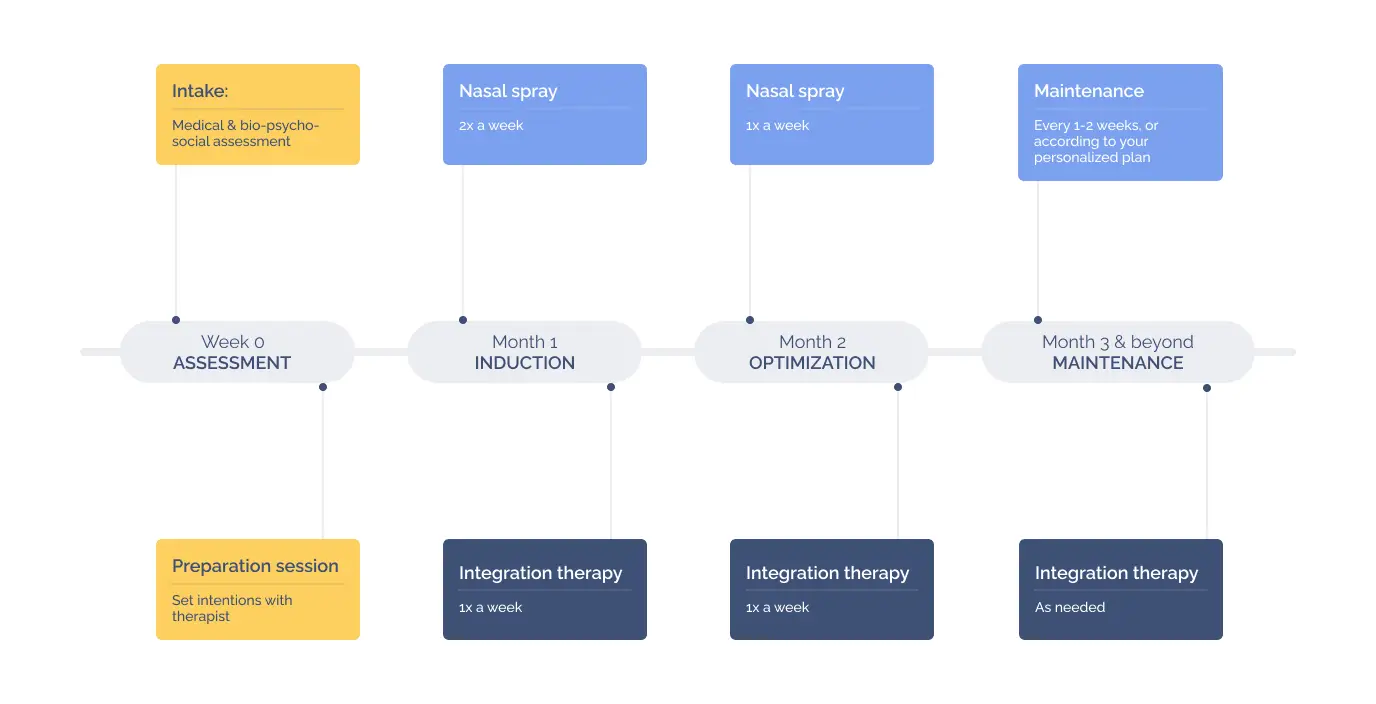
The exact number of sessions in each phase depends on the treatment type, your exact diagnosis and how you respond along the way. Some patients feel a shift in mood after their first few sessions. Others need the full induction series before noticing meaningful change.
Spravato treatment protocol
Spravato (an esketamine-based nasal spray) follows a more standardized, FDA-approved dosing schedule.
| Phase | What to expect |
|---|---|
|
1
Induction
|
Eight sessions over four weeks, twice a week. Each session lasts about two hours, including the required observation period after dosing. |
|
2
Optimization
|
After induction, many patients move to a weekly optimization phase for about four weeks. |
|
3
Maintenance
|
A personalized schedule from there. Your care team adjusts the frequency based on how you are responding. |
IV ketamine treatment protocol
IV ketamine, sometimes called a ketamine infusion, is delivered in a private, supervised clinical setting. This method may be appropriate for patients who have not responded to oral antidepressants, and its dosing can be adjusted more precisely than other delivery methods.
| Phase | What to expect |
|---|---|
|
1
Induction
|
Six infusions over three weeks, typically scheduled twice per week. Some patients need up to 6–8 sessions across three to four weeks depending on how they respond. Each infusion lasts about 45 minutes, followed by a short observation period. |
|
2
Maintenance
|
After induction, patients typically move to monthly booster infusions, adjusted based on how long the benefits last. Your clinician will help determine the right maintenance interval based on your response. |
What affects your number of treatments for depression
No two treatment plans look exactly alike. A few factors that influence how many sessions you may need include:
- Severity and duration of depression symptoms
- How you respond during the induction phase
- Whether you are also engaged in complementary therapy, such as cognitive behavioral therapy (CBT) or ketamine-assisted psychotherapy (KAP)
- Any co-occurring conditions your care team is monitoring
Your treatment team at Keta Medical Center will reassess your progress throughout the induction phase and adjust your plan as needed. This is not a one-size-fits-all process. It’s an evolving plan built around your specific response to treatment.
What to expect at Keta Medical Center
Every patient begins with a clinical evaluation to determine whether IV ketamine, Spravato or another approach is the right fit. From there, our team maps out a personalized schedule, walks you through what each session involves and stays closely connected with you as your treatment progresses.
If you’re living with treatment-resistant depression and want to understand your options, our clinical team can help you find the path that makes sense for you.
A note on insurance coverage
Because Spravato is FDA-approved specifically for treatment-resistant depression, it’s typically covered by insurance, including many commercial plans.
IV ketamine, by contrast, is used off-label for depression, which means it’s less consistently covered and is often billed as an out-of-pocket treatment.
Our team can help verify insurance coverage and walk you through what to expect before you begin treatment.
Simply book a free consultation to talk with our team about which ketamine treatment plan may be right for you.